Printable Homework Routine Kit for Study Habits & Independence
Homework Help Made Easy: A Printable Toolkit for Building Study Habits and Independent Learning
Homework goes more smoothly when routines, expectations, and support tools are consistent. A calm, repeatable system can reduce nightly stress, cut down on reminders, and help kids build skills they can use long after the assignment is turned in. Below is a practical, parent-friendly approach for setting up a steady homework flow, teaching study habits that stick, and gradually helping students work more independently—powered by simple printables and a few reliable prompts.
What “homework help” looks like when it actually helps
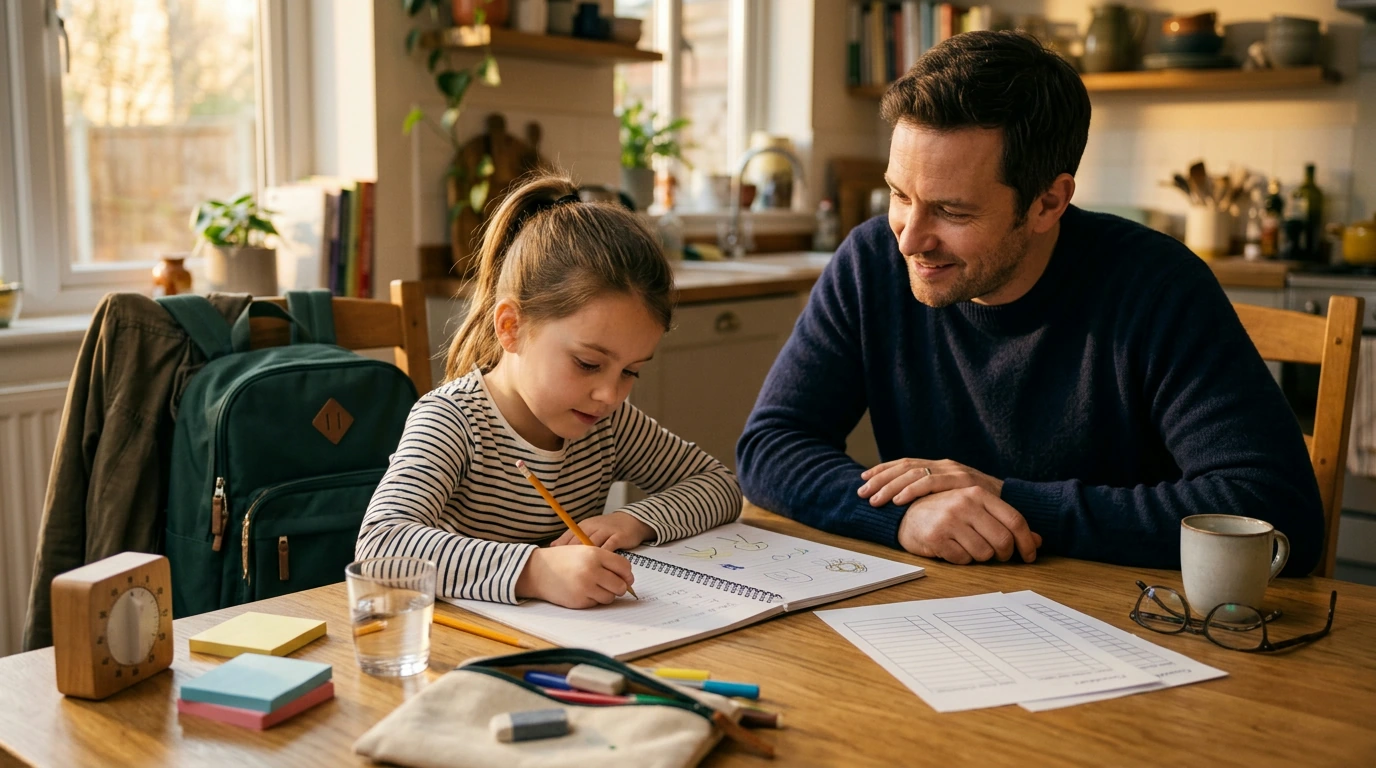
Effective homework help isn’t about hovering or re-teaching every concept at the kitchen table. It’s about building a process your child can repeat on their own: plan → start → check → reflect. When the same steps happen in the same order most nights, the routine becomes automatic and the negotiations fade.
- Shift the goal from “getting it done” to learning a repeatable routine that works for different subjects.
- Keep the parent role as coach: provide structure and prompts rather than rescuing, correcting every detail, or doing the hard parts.
- Watch for common friction points: unclear directions, weak time awareness, low confidence, distractions, and missing materials.
- Use consistent steps nightly so your child knows what happens next without a debate.
Research-backed study strategies (like active recall and spaced practice) also support longer-term learning, not just short-term completion—see overviews from the American Psychological Association and practical guidance from Harvard Graduate School of Education.
Set up a homework routine that reduces stress
Consistency matters more than perfection. Pick a start time that’s anchored to an existing habit (snack, short movement break, then work). Add a “ready-to-start” checklist so you’re not hunting for pencils, chargers, or logins when motivation is already low.
- Choose a consistent start time tied to the same pre-homework routine.
- Create a “ready-to-start” checklist: supplies, charged device, water, assignment list, quiet space.
- Keep sessions short with planned breaks (especially for younger students or kids with attention challenges).
- Use a visible end point: a done list, quick pack-up routine, and a brief reset of the workspace.
Sample weekday homework routine (adjust by age and workload)
| Step | Time | What it looks like | Parent prompt |
|---|---|---|---|
| Reset + materials | 5 min | Clear desk, get supplies, open planner/LMS | “Show me what you need before you start.” |
| Plan the work | 3 min | List tasks, pick the first one, estimate time | “Which one is quickest to start?” |
| Work block 1 | 15–25 min | Focused work; phone out of reach | “What’s the first step?” |
| Break | 5 min | Water, stretch, short movement | “Break ends when the timer rings.” |
| Work block 2 | 15–25 min | Continue/finish; quick self-check | “Check directions and one example.” |
| Pack + preview | 3–5 min | Put work in folder; check tomorrow’s needs | “What do you need ready for tomorrow?” |
Teach study habits with simple, repeatable strategies
Homework gets easier when kids aren’t relying on memory alone. A few repeatable strategies—practiced in small doses—build durable study habits and reduce last-minute panic.
- Planning: use a weekly overview for tests/projects and a daily “top 3” list for homework tasks.
- Chunking: break assignments into steps with mini-deadlines (start, draft, revise, submit).
- Active recall: close notes and retrieve key ideas (quick quiz, flashcards, teach-back).
- Spaced practice: revisit material across several days instead of one long cram session.
- Self-check routines: directions check, example problem check, and “does this answer make sense?” check.
To make these habits stick, keep the tools visible and the steps short. A one-page checklist often works better than a complicated planner system that adds more work.
Build independence without power struggles
Independence grows fastest when support is predictable and gradually reduced. Start by demonstrating a routine once, then do one together, then shift to observing while your child runs the process.
- Use gradual release: demonstrate once, do one together, then observe while they do it.
- Swap repeated explanations for prompts: “Where could you find that?” “What does the rubric say?” “What’s the next step?”
- Set a simple help rule: try for 5 minutes, write a specific question, then ask for help.
- Normalize productive struggle; praise effort, strategies, and follow-through rather than perfection.
When homework becomes a daily battle: quick troubleshooting
Printable tools that keep the system consistent
Recommended tools from our store
- Homework Help Made Easy Toolkit for Parents – Printable Guide for Creating Study Habits, Homework Strategies & Independent Learning ($7.99): a structured set of printable pages for planning, checklists, reflection, and simple parent prompts.
- Black Cat Reflective Laser Phone Case for iPhone ($5.01): a practical add-on for families using a “phone away during work blocks” rule—easy to grab and relocate to a designated spot while keeping the device protected.
A simple weekly reset to keep homework from piling up
FAQ
How long should homework take each night?
A common guideline is about 10 minutes per grade level (for example, around 30 minutes in 3rd grade and about 60 minutes in 6th), but it varies by student and school. If homework consistently exceeds a reasonable time cap, pause, note what was completed, and communicate with the teacher about the workload.
What can parents do if a child refuses to start homework?
Keep the routine calm and predictable: short snack/movement break, then a 2-minute starter task, then a timer for a short work block. Offer a simple choice (which assignment first) and tie privileges to effort and follow-through rather than arguing about the work itself.
How can a child become more independent without sacrificing accuracy?
Use gradual release (show, do together, then observe) and prompt-based help instead of giving answers. Pair that with a quick self-check checklist and a “try first, then ask” rule so your child builds both independence and a consistent quality-control habit.















Leave a comment