8ct Round Moissanite Ring: GRA Certified Luxury Sparkle
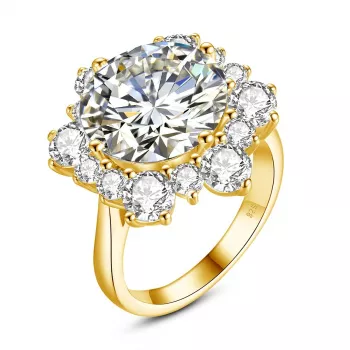
Massive 8ct Round Cut Moissanite Ring with GRA Certification – Luxury Engagement Ring
A bold 8ct round-cut moissanite engagement ring delivers maximum sparkle and presence without the fragility or price shock of a comparable diamond look. The appeal is simple: a large, bright round stone that reads “luxury” from across the room, paired with the practicality of moissanite’s durability and everyday-friendly care.
For shoppers considering a statement center stone, the biggest wins come from understanding true face-up size (in millimeters), what included paperwork does and doesn’t confirm, and how setting details affect comfort over time.
Why an 8ct Round-Cut Moissanite Makes a Statement
Round brilliant cuts are engineered for strong light return, so they tend to stay bright and lively even when the stone is large. At an 8ct-equivalent look, that brightness becomes the defining feature: the ring has serious finger coverage, is clearly visible at arm’s length, and photographs with a “spotlight” effect under both indoor lighting and sunlight.
Moissanite is also known for pronounced fire (those colored flashes that pop as you move your hand). On a massive round, that fire becomes more noticeable—perfect for anyone who prefers high drama over a subtler, diamond-like shimmer. This style fits best for bold jewelry lovers, frequent compliment-getters, and anyone who wants a confident, cocktail-luxe profile in an engagement ring silhouette.
Quick Specs Checklist for This Ring
If you’re shopping a large center stone online, focus on verifiable details: measurements, cut quality, and secure construction. The featured piece is the Massive 8ct Round Cut Moissanite Ring with GRA Certification – Luxury Engagement Ring, designed to deliver an upscale look at a budget-friendly price point.
For a coordinated look (or a bold partner option), consider pairing it with a complementary moissanite style like the Platinum Men’s Ring with Moissanite Diamond.
At-a-Glance: What to Confirm Before Ordering
| Detail to check | Why it matters | What “good” looks like |
|---|---|---|
| Stone diameter (mm) | Tells the real face-up size on the finger | Matches an 8ct-equivalent look for round stones |
| Cut quality | Controls sparkle, brightness, and symmetry | Even facets, strong return, no obvious dull areas |
| Setting height | Affects comfort and snag risk | Secure but wearable for daily use |
| Band width/thickness | Supports a heavy visual center stone | Balanced proportions that don’t look “top-heavy” |
| Prong security | Prevents loosening and loss | Even prongs, tight seat, smooth finish |
| Metal type & plating (if applicable) | Determines color, wear, and skin sensitivity | Clear metal description; hypoallergenic options if needed |
| GRA certificate details | Helps match paperwork to the stone | Consistent stone size/grade info; any ID/inscription aligns |
Understanding “8ct” in Moissanite: Size, Proportions, and Wearability
Moissanite is often marketed using diamond-equivalent carat language, but carat is a measure of weight—not the measurement your eye reads on the hand. The most reliable way to confirm “how big it looks” is the stone’s millimeter diameter and depth. If millimeters are listed, use them as your north star; if they aren’t, request them before ordering.
At very large sizes, proportions and setting style can make the same mm measurement look different. A higher crown can boost sparkle and “presence,” while a halo or elevated mounting can increase perceived size even further. That extra presence comes with trade-offs: taller rings are more likely to bump hard surfaces, catch on sweaters, or feel intrusive if you wear gloves frequently.
For daily wear, prioritize a setting that shields prongs and reduces snag points—especially around the gallery and the prong tips. A well-designed mounting makes an oversized stone feel secure rather than precarious.
GRA Certification: What It Can (and Can’t) Tell You
A GRA certificate is commonly included with moissanite jewelry as supporting documentation that lists stone details and identifying notes. It’s useful for matching a ring to its paperwork and for keeping organized records, but it shouldn’t be treated as a universal, apples-to-apples grading standard across the entire jewelry industry.
What matters most is consistency: the certificate details should match the product listing (shape, stated size, and any noted characteristics). If the stone includes an inscription number, verify that it aligns with the certificate. For additional peace of mind—especially with a large, high-impact ring—many buyers choose a quick inspection by a local jeweler or a third-party appraisal after delivery.
For consumer transparency on jewelry claims and labeling, the Federal Trade Commission’s Jewelry Guides are a helpful reference. For general background on moissanite as a gemstone material, Britannica’s overview of moissanite provides accessible context.
What Makes a Ring Feel “Luxury” Beyond the Stone
On a massive ring, the small construction details are what separate “big” from “high-end.” A large stone with poor symmetry can look glassy or uneven, while a well-cut round stays crisp with bright return across the entire face.
Care Tips for a Massive Moissanite Ring
When This Style Is the Right Choice (and When It Isn’t)
FAQ
Is an 8ct moissanite ring suitable for daily wear?
Yes for many people, but it depends on setting height and lifestyle. Choose a secure setting that minimizes snagging, remove it for rough work, and check prongs regularly to keep it safe and comfortable.
What does a GRA certificate mean for a moissanite ring?
It’s included documentation that typically lists identifying details about the stone. Match the certificate information to the listing and any stone inscription if present, and consider an independent inspection if you want additional verification.
How can the ring be cleaned to keep maximum sparkle?
Use warm water, mild dish soap, and a soft brush, then rinse well and dry with a lint-free cloth. Avoid harsh chemicals when possible and schedule periodic checks to confirm the prongs remain tight and even.













Leave a comment