4-Week At-Home Workout Plan: Minimal Equipment, Daily
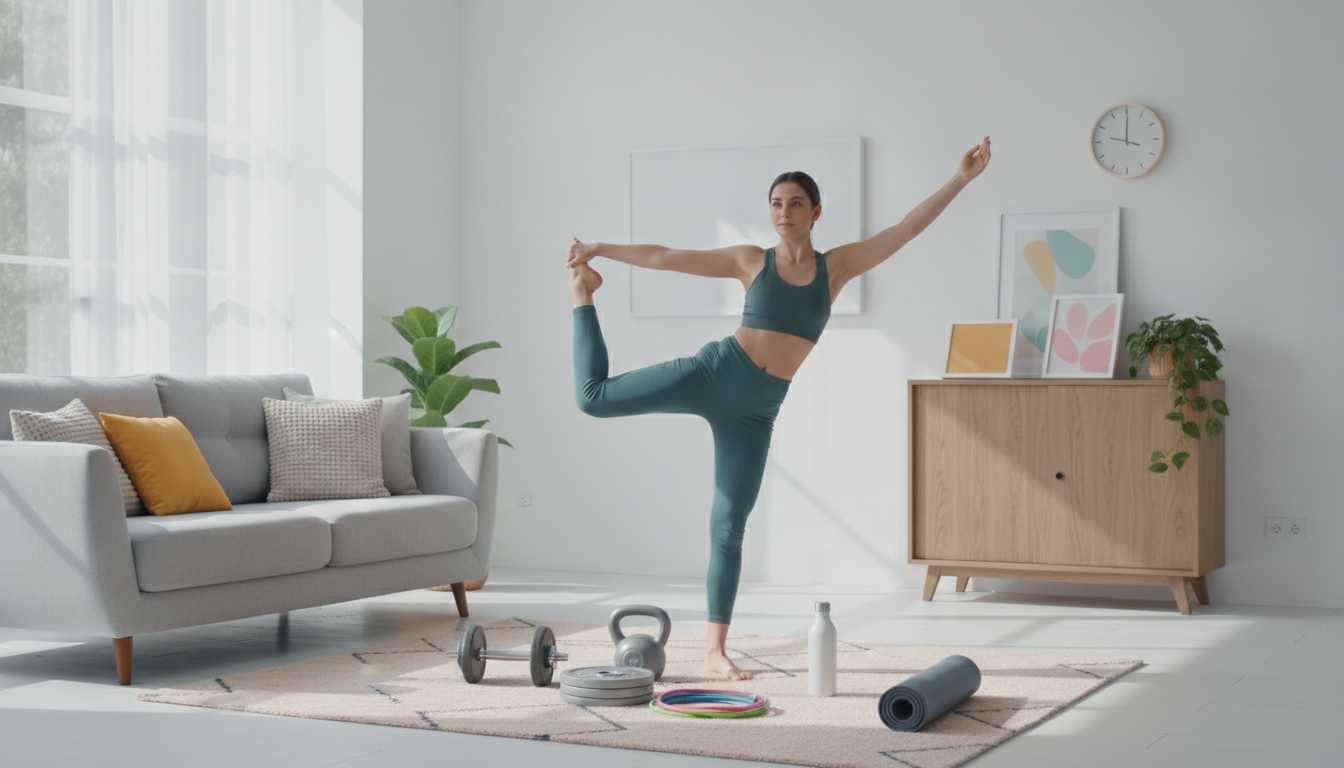
Fit at Home: A 4-Week Minimal-Equipment Workout Plan With Daily Workouts and Stretches
A structured month of at-home training can build consistency without requiring a full gym. This 4-week plan uses minimal equipment, clear daily sessions, and simple stretching to support strength, mobility, and conditioning in a realistic schedule. It’s designed to fit into a small space, scale up or down, and keep you moving with a repeatable rhythm you can actually stick with.
What This 4-Week Plan Is Designed to Do
- Create a repeatable weekly rhythm: strength days, conditioning days, mobility, and recovery
- Train the whole body with minimal equipment using scalable movements
- Improve movement quality with short daily stretch routines
- Support adherence with clear session structure, warm-ups, and progression guidance
Across four weeks, you’ll repeat the same weekly “skeleton” while progressing the difficulty in small, manageable ways—more reps, slightly heavier load, or a bit less rest. That kind of steady progression pairs well with widely recommended activity targets from the Physical Activity Guidelines for Americans (2nd edition), especially when you’re building the habit of moving most days.
Minimal Equipment Setup (and No-Equipment Options)
- Core items that expand variety: a pair of dumbbells or a resistance band, a stable chair/bench, and a yoga mat or towel
- Helpful add-ons (optional): a loop band for glutes, a jump rope, a light kettlebell
- No-equipment substitutes: backpack with books for loading, towels for sliders, stairs for step-ups
- Space considerations: a clear 6×6 ft area covers most sessions
Equipment swaps for common movements
| Movement goal | Minimal equipment | No-equipment alternative |
|---|---|---|
| Squat pattern | Dumbbell goblet squat | Air squat with slow tempo |
| Hip hinge | Dumbbell RDL | Single-leg hinge / good morning |
| Pressing | Dumbbell floor press | Push-ups (elevated if needed) |
| Pulling | Band rows | Towel isometrics / reverse snow angels |
| Conditioning | Jump rope | High knees / marching intervals |
How to Use the Daily Workouts and Stretches
- Session flow: 5–8 minute warm-up, 20–35 minute main work, 5–10 minute stretch
- Effort guide: keep 1–3 reps in reserve on strength sets; use steady breathing on conditioning intervals
- Progression across 4 weeks: add 1–2 reps per set, increase load slightly, or reduce rest by 10–15 seconds
- Recovery basics: sleep, hydration, protein intake, and at least one lighter day each week
Keep form crisp and repeatable. If you’re unsure how an exercise should look, the American Council on Exercise (ACE) has a large exercise library and general training guidance that can help you check technique cues.
Week-at-a-Glance Schedule (Repeat and Progress for 4 Weeks)
- Day 1: Lower-body strength + core
- Day 2: Upper-body strength + posture
- Day 3: Conditioning + mobility
- Day 4: Full-body strength circuit
- Day 5: Low-impact conditioning + core
- Day 6: Mobility and stretch focus
- Day 7: Rest or gentle walk
Sample weekly structure (adjustable for beginners and intermediate)
| Day | Focus | Main moves (examples) | Time |
|---|---|---|---|
| 1 | Lower + core | Squat, hinge, lunge, plank variations | 30–45 min |
| 2 | Upper + posture | Push-ups/press, rows, shoulders, carries | 30–45 min |
| 3 | Conditioning + mobility | Intervals + hips/ankles/thoracic work | 25–40 min |
| 4 | Full-body circuit | Total-body compound pattern circuit | 30–45 min |
| 5 | Low-impact cardio + core | Marching, step-ups, anti-rotation | 25–40 min |
| 6 | Stretch and mobility | Full-body stretch sequence | 15–30 min |
| 7 | Rest | Walk, easy stretch, breathing drills | 0–30 min |
Daily workout templates (repeat weekly and progress)
Day 1 – Lower + core: Warm-up (hip circles, glute bridges, bodyweight squats). Main work: goblet squat 3–4 sets of 6–10, dumbbell or backpack RDL 3–4 sets of 8–12, step-back lunge 2–3 sets of 8–10/side, plank 3 rounds of 20–45 seconds. Rest 60–90 seconds between sets.
Day 2 – Upper + posture: Warm-up (arm circles, scapular push-ups, band pull-aparts). Main work: push-ups or dumbbell floor press 3–4 sets of 6–12, band row or towel isometric row 3–4 sets of 10–15, shoulder press (dumbbells or pike push-up progression) 2–3 sets of 6–10, suitcase carry (one dumbbell/backpack) 3 x 30–60 seconds/side.
Day 3 – Conditioning + mobility: Choose a low-impact interval: 30 seconds brisk marching + 30 seconds easy pace for 12–20 minutes, or jump rope 20 seconds on/40 seconds off for 10–15 rounds. Finish with mobility (ankle rocks, thoracic rotations, deep squat hold).
Daily Stretching: Simple Routines That Pair With Training
Modifications for Different Fitness Levels
What’s Included in the Fit at Home 4-Week Workout Plan PDF
If you want everything laid out day by day, use the printable guide here: Fit at Home: 4-Week Workout Plan | Minimal Equipment Exercise Guide PDF | Home Fitness eBook with Daily Workouts & Stretches.
For at-home sessions, a phone often doubles as your timer and music source. If you train outdoors or toss your phone in a gym bag, this can help protect it: Black Cat Reflective Laser Phone Case for iPhone.
FAQ
How long are the daily workouts?
Most sessions run about 25–45 minutes including warm-up and stretching. To shorten, cut one strength set per exercise or reduce the number of conditioning intervals; mobility-focused days can be 15–30 minutes.
What equipment is actually needed to follow the plan?
A mat or towel and a stable chair/bench cover the basics, with dumbbells or a resistance band adding more options. If you don’t have weights, a backpack with books, towels for sliders, and stairs for step-ups work well.
Is this plan suitable for beginners?
Yes—use easier variations (like incline push-ups), fewer total sets, longer rest, and shorter intervals. Stop if you feel sharp pain, and consider a medical professional or qualified trainer if you have injuries or health concerns.















Leave a comment